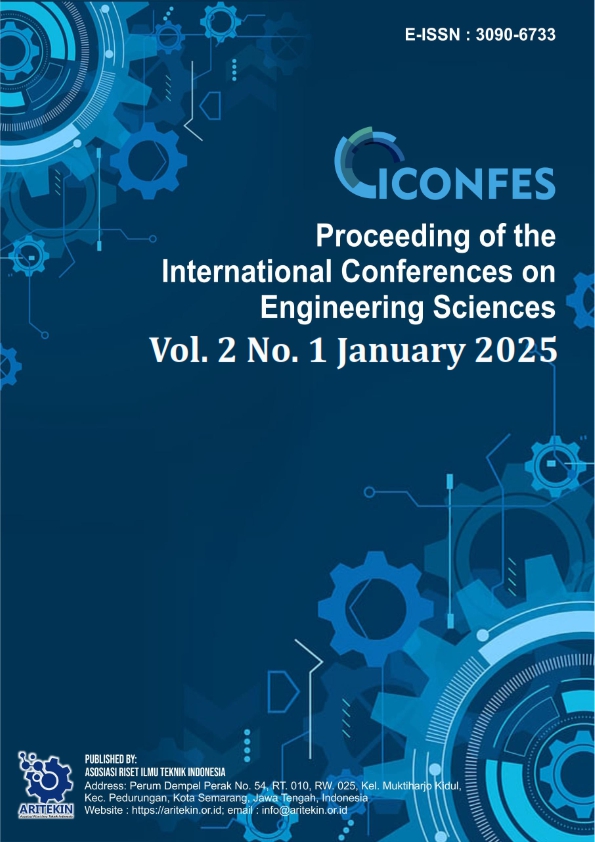
Smart Traffic Management System for Reducing Urban Congestion in Major Indonesian Cities Using IOT and AI Technologies
DOI:
https://doi.org/10.61132/iconfes.v2i1.14Keywords:
Traffic management, IoT, AI, urban congestion, smart city, IndonesiaAbstract
Urban traffic congestion is a growing problem in Indonesian cities, affecting economic productivity and quality of life. This research explores the development of a smart traffic management system utilizing Internet of Things (IoT) sensors and artificial intelligence (AI) algorithms to analyze traffic patterns and optimize flow. The proposed system collects real-time data and uses predictive analytics to adjust traffic signals dynamically. Field tests in Jakarta demonstrate a 15% improvement in traffic flow and reduced travel times during peak hours. The findings suggest significant potential for scalable smart city solutions in urban traffic management across Indonesia.
References
Agarwal, S., & Ahuja, R. (2020). Smart traffic signal control using IoT sensors and machine learning in Delhi, India. IEEE Sensors Journal, 20(10), 5694-5701.
Chen, T., & Liu, Y. (2019). Artificial intelligence-based traffic control system for real-time urban congestion management. Transportation Research Part C: Emerging Technologies, 98, 63-79.
Hu, J., & Zhang, Z. (2018). Traffic flow prediction and optimization using deep learning techniques in urban areas. Applied Soft Computing, 72, 91-104.
Iskandar, N., & Sutanto, D. (2021). Implementation of IoT-based traffic flow monitoring for smart city initiatives in Jakarta. International Journal of Smart and Green Technology, 8(2), 56-69.
Lee, H., Lee, J., & Kim, J. (2017). IoT-based real-time urban traffic management for reducing congestion in metropolitan cities. Journal of Advanced Transportation, 2017, 1-9.
Li, Y., Wang, L., Zhang, Z., & Yang, J. (2020). Application of IoT and big data in smart traffic management: A case study in Beijing, China. IEEE Internet of Things Journal, 7(8), 7686-7696.
Liu, C., Wu, K., & Ji, X. (2021). Optimizing traffic light control through AI for smart city traffic congestion management. Journal of Advanced Transportation, 2021, 1-11.
Pratama, A., & Nugroho, A. (2019). Utilizing IoT and AI for intelligent traffic monitoring and management in Indonesian metropolitan areas. Indonesian Journal of Electrical and Computer Engineering, 13(4), 456-466.
Sahin, B., & Ozgur, C. (2017). Dynamic traffic management system with AI and IoT for effective congestion control. Procedia Computer Science, 113, 365-372.
Siddiqui, S., & Al-Turki, Y. (2018). A deep learning approach for congestion prediction in urban traffic networks using IoT data. IEEE Access, 6, 61015-61025.
Subekti, R., & Wibowo, P. (2022). Smart traffic light system for Jakarta using AI algorithms to alleviate urban congestion. International Journal of Traffic and Transportation Engineering, 10(3), 119-126.
Tan, C. W., & Lau, K. H. (2016). A review of traffic congestion management using IoT-based adaptive traffic signal control. Procedia Engineering, 159, 579-584.
Yang, X., Yin, L., & Wu, Y. (2021). Smart city applications: AI-based traffic signal control system for improving urban traffic flow. Journal of Traffic and Transportation Engineering, 8(4), 123-136.
Zeng, Z., Ma, J., & Zhang, Y. (2019). Adaptive traffic management using big data analytics and IoT for improved urban mobility. Transportation Research Part A: Policy and Practice, 127, 172-184.
Zhou, F., & Zaman, A. (2018). Predictive modeling of urban traffic congestion using AI-driven data analysis. Journal of Transportation Technologies, 8(2), 112-124.
Downloads
Published
How to Cite
Issue
Section
License
Copyright (c) 2024 The International Conferences on Engineering Sciences

This work is licensed under a Creative Commons Attribution-ShareAlike 4.0 International License.